
After a 15-year run, the previous Dodge Charger departed as the last American sedan that could plausibly serve as both the family muscle car. Its absence left a conspicuous gap, which remains buried beneath an avalanche of crossovers. When Dodge introduced the latest Charger as a two-door coupe, a four-door version felt inevitable. Now that it has arrived, the Charger once again occupies a segment of one: a large, unapologetically American performance sedan for buyers who need rear doors but have not yet surrendered to the gravitational pull of a three-row utility vehicle.
Our previous encounter with the two-door Charger involved the more powerful High-Output powertrain. This four-door arrived in the R/T S.O. form, with “S.O.” standing for Standard Output. Its 3.0-liter twin-turbocharged inline-six produces 430 horsepower and 469 lb-ft of torque. The Scat Pack receives the High-Output version, matching the coupe with 550 horsepower and 531 lb-ft. Both versions use standard all-wheel drive, giving the new Charger year-round traction and a degree of civility its tire-smoking ancestors might regard with suspicion.


From behind the wheel, the difference between the two-door and four-door body styles is less pronounced than the extra pair of doors suggests. The R/T uses an eight-speed automatic, and although its exhaust does not deliver the Scat Pack’s full catalog of snaps, crackles, and pops, it still contributes an occasional burp at the end of a shift. Think of less fireworks display, and more of a satisfied dinner guest. In a straight line, the R/T feels genuinely quick. It launches with enthusiasm, builds speed without hesitation, and never makes its Standard Output designation feel like an apology.
The R/T is not as rambunctious as the Scat Pack, but Dodge has left enough adjustability to keep the experience interesting. In Auto or Normal mode, the all-wheel-drive system maintains an approximately 50/50 distribution between the front and rear axles, prioritizing stability and everyday usability. Select Sport mode and the system sends roughly 60 percent of the power rearward while relaxing the electronic supervision, adding a welcome measure of movement and drama. Track mode goes further, allowing 100 percent rear-wheel drive. That setting creates a useful playground for experienced drivers who want to explore the car’s limits; or, more realistically, discover their own.


Yet the Charger’s most persuasive quality may be its ability to settle down. For all the performance theater, it remains a refined cruiser when the occasion calls for restraint. It does not behave like a bruiser attempting a last-minute impression. Instead, it carries itself more like a grand tourer; comfortable over long stretches, composed at speed, and ready to produce a meaningful surge when the accelerator is pressed. The squared-off steering wheel provides a secure grip, while the chassis manages its considerable mass with more composure than its dimensions suggest. Braking is prompt, progressive, and predictable. That should be expected in a car with this much power, but meeting basic expectations has become sufficiently rare that it now deserves acknowledgment.
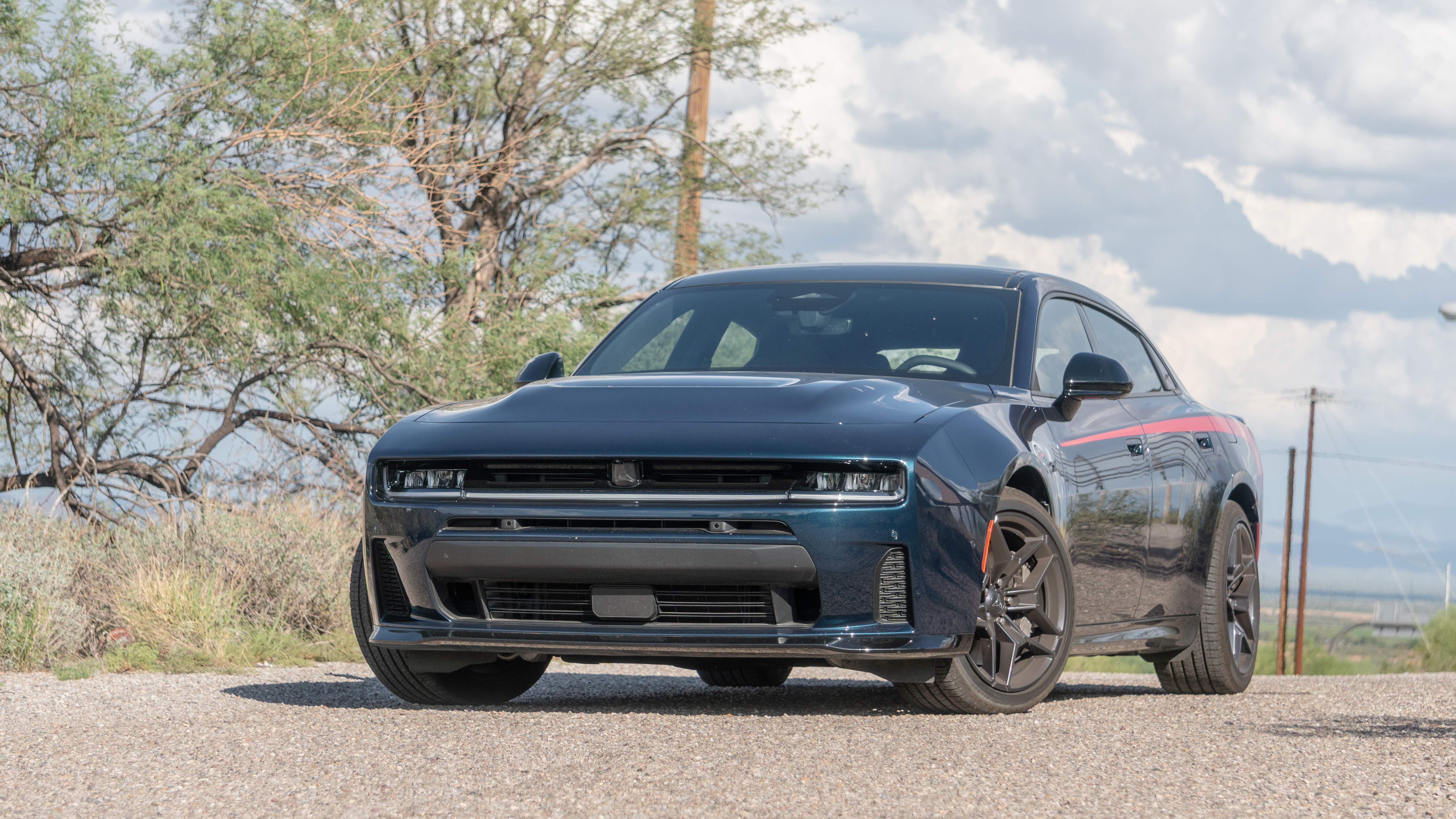
Visually, the four-door remains remarkably close to the coupe. The fundamental exterior design is unchanged; the principal difference is exactly what the name promises; shorter front doors and two additional openings behind them. Dodge has integrated those rear doors without making the sedan look like an afterthought, preserving the broad stance and clean proportions of the two-door. The cabin is similarly familiar, but the added doors transform its usefulness. Rear-seat access is straightforward, and the space itself is generous enough for three adults to ride in reasonable comfort.
Dodge also deserves credit for the coherence of the interior layout. The dual-screen arrangement is well proportioned rather than simply large for the sake of appearing technologically serious. The infotainment display angles toward the driver, improving reach and visibility, and the physical controls have enough substance to feel deliberate. Even the gear selector provides a welcome tactile reminder that the PRNDL is more than an abstract concept floating somewhere inside a touchscreen. Ambient lighting adds atmosphere without overwhelming the cabin. It is visible during the day, restrained at night, and effective at communicating the Charger’s modern character without forcing the interior to compete with its own engine note.


A second look at the Charger lineup, however, makes its shortcomings harder to overlook; particularly when our R/T’s price crept beyond $67,000. The car may have little direct competition, but Dodge is clearly pursuing a premium customer, and portions of the cabin do not support that ambition. Several surfaces feel like inexpensive hard plastic, which is difficult to reconcile with the window sticker. The illuminated ribbed inserts across the doors and dashboard look dramatic, especially after dark, but the material itself still feels unyielding. Those grooves also seem designed to collect dust with the efficiency of a laboratory instrument. The lighting creates a cool ambience; maintaining it may require a tiny brush, patience, and a level of domestic commitment not normally included in an options package.
Those materials matter because the new Charger is attempting a difficult balancing act. It must preserve the attitude that made the nameplate distinctive while becoming more sophisticated, more practical, and easier to live with every day. In performance and road manners, Dodge has largely succeeded. The R/T is quick without being exhausting, adjustable without becoming theatrical in every setting, and comfortable enough to cover serious distance. The four-door restores the everyday usefulness that helped define the previous Charger.




Leave a Reply